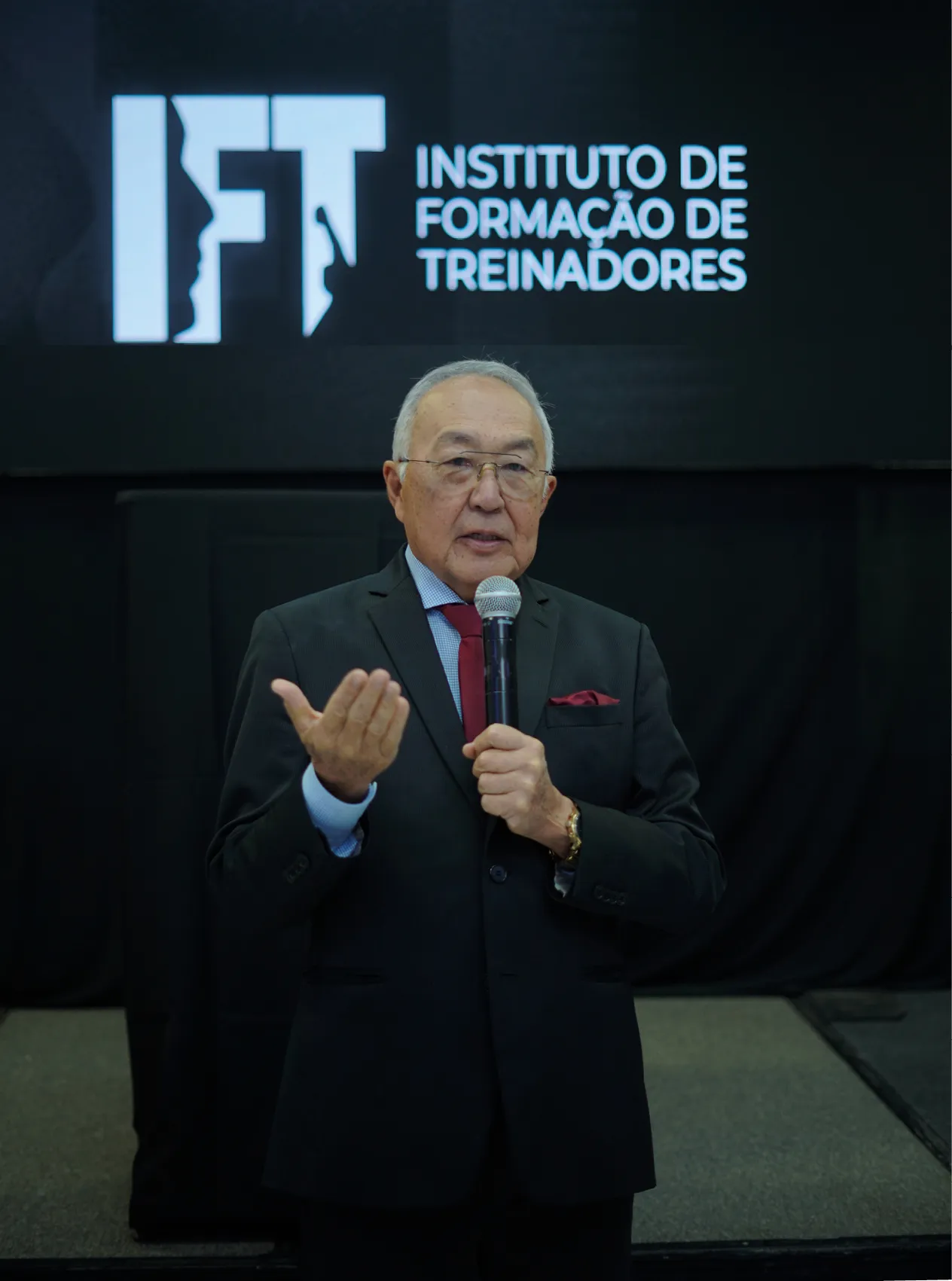
He walks into the room with the same energy as someone who has just stepped onto a stage for the first time. Strong voice, bright eyes, an easy smile. Massaru Ogata is 80 years old — or, as he likes to say, "80,000 kilometres on the clock, 2026 Turbo model, still running at full speed." The joke reveals far more than humour: it is the philosophy of a man who never stopped moving forward, even when the road closed in front of him.
The son of Japanese immigrants, Massaru carries in his surname a symbolism he need not explain — the discipline, the method and the commitment that permeate every training session, every talk, every decision along his journey. Born in 1946, he was built — as he likes to say — in a Brazil that was still finding its feet in the culture of human development. And it was precisely that Brazil he helped to transform.
The story begins in Maringá, where a young Johnson & Johnson sales representative discovered he could sell — but that what truly drove him was teaching others to do the same. In a year and a half, he broke sales records. Promotions came quickly, one after another, until he reached the position of national manager for training and human development at the company. He spent 17 years there — 12 of them dedicated entirely to developing people. But Johnson wasn't just a job. For Massaru, it was his.
"I thought like an owner of the company the whole time," he recalls. "While I was there, I gave my best — and when I decided to leave, Johnson was my first major client." That sentence captures one of the central lessons he carries into every training: genuine loyalty is not naivety, it is a long-term strategy. Those who serve well, reap the rewards.
The turning point came at 45, at the crossroads he calls the "Y-shaped career." On one side, the security of continuing as an executive, with a structured retirement plan and a director title on the horizon. On the other, the dream of entrepreneurship — taking everything he had learned and sought out, even on holidays, even outside Brazil, to the market. He chose the entrepreneurial path. But it was no leap in the dark: five years of quiet preparation, building up financial reserves and knowledge, travelling internationally in search of training programmes that Brazil had not yet developed. "So as not to be a headless sperm," he laughs, explaining that he saved enough to survive five years without closing a single contract. "You have to blow up the bridge — but only after you've built the new crossing."
"I prepared a great deal," he says. "At first, I was a glass of water on my head. From so much seeking, I became a water tank. But my positive ambition has always been a waterfall — and I'm still working my way there." That waterfall has a name: the IFT, the Instituto de Formação de Treinadores, which he founded when he was around 62. A second foundation. A second beginning. At 80, he prefers to call it the climax.
The recipe you can build upon
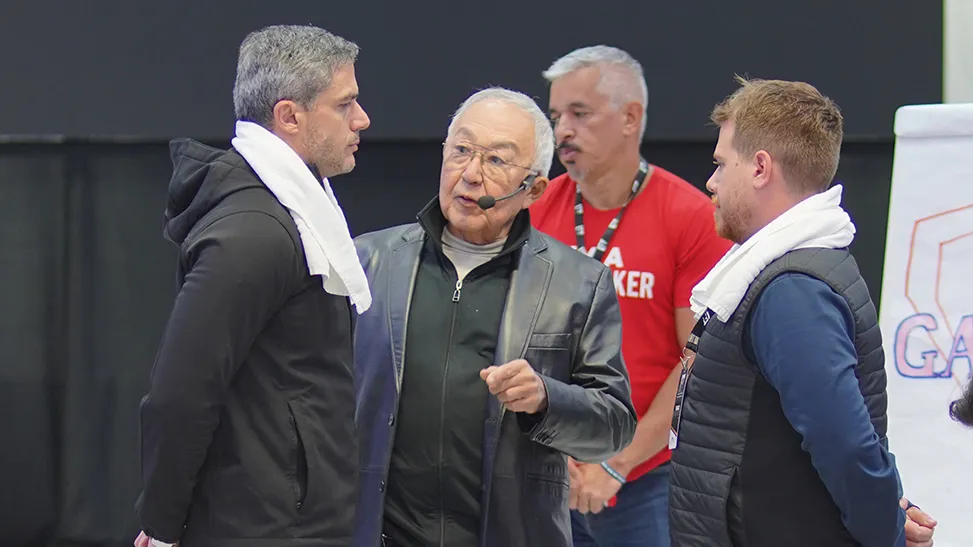
IFT was born from a simple and vertiginous question: is it possible to compress 35 years of experience as a trainer into seven days? Massaru put it down on paper, item by item, and discovered that yes, it was. Today, 18 years later, more than 2,500 trainers have been certified through the institute's methodology — the first and largest of its kind in Brazil. Among them are names the market knows well: Marcos Marques, son of the IBC founder and now considered a billionaire in the training sector, took the IFT course in its second edition, alongside his father. Wendell Carvalho, who has trained more than 117,000 people, also shares the same origin. Jerônimo Temel is another name who enriched the methodology through the institute's training.
Massaru does not produce clones. He delivers a recipe — and encourages students to build on it. "You receive the paella recipe," he explains, with the clarity of someone who has spent decades translating complex concepts into simple images, "but if your fridge has prawns, lobster, crayfish, you can throw it all in and create a dish that not even the cat would leave alone." IFT does not mass-produce trainers. It develops professionals who find their own flavour.
The programme covers everything from ninety-minute talks to full week-long immersions — seven days with him on stage, from eight in the morning until night, without a microphone for part of his story ("back at Johnson, there wasn't even a microphone"), without losing his voice, without dropping his energy. Within that week, participants experience group dynamics, experiential activities both outdoors and indoors, neuro-linguistic programming, transactional analysis, gestalt training, situational leadership and public speaking techniques. Each dynamic comes with a structured debrief — the moment when he explains not just what happened, but how and why it can be replicated. It is there that the trainer is born, not in the certificate. For those who see him up close, this is not effort. It is what happens when a person finds their purpose and decides to live inside it.
And the support does not end at graduation. The IFT ecosystem includes post-training mentoring, accompaniment through the first training session, a content platform and a community of trainers who recognise each other by the same shared origin. "We don't train people and then abandon them," he says. "Whoever enters the ecosystem doesn't leave." Not from dependency, but from belonging.
The leader who needs to learn to delegate
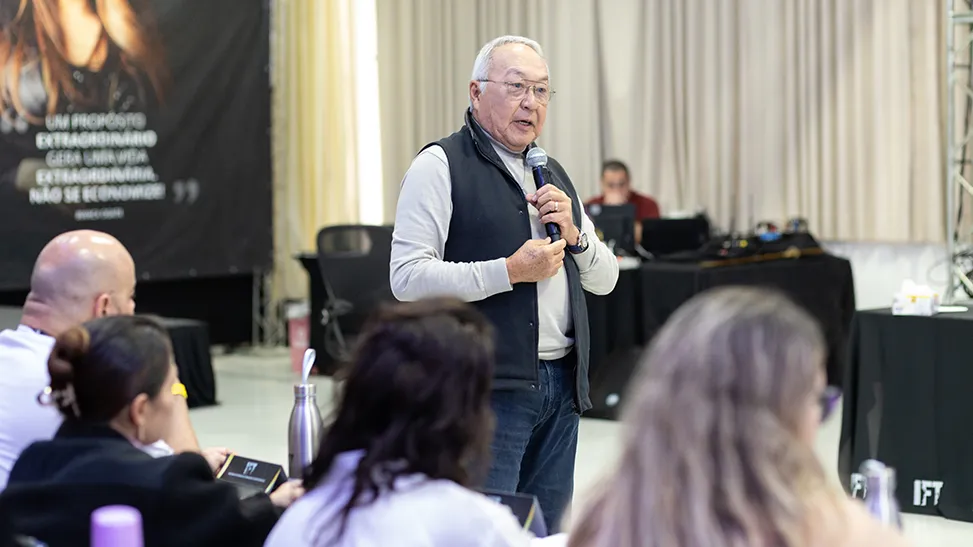
Beyond IFT, Massaru Ogata is a national reference in situational leadership — a methodology he has applied in companies for decades and summarises in a devastatingly precise phrase: "Nothing is as unequal as treating different employees the same way." The sentence invariably produces the same silence in the room. Because it is too true to be ignored.
Situational leadership starts from an apparently simple principle: the manager needs to identify what level of development each team member is at for each specific task — and adjust their leadership style accordingly. An employee who does not yet know how to carry out a particular function needs direction, not praise. Another who knows how to do it but is unmotivated needs encouragement, not micromanagement. It seems obvious. Yet most companies treat everyone the same — and get the results they deserve.
"The greatest pain I see in business owners is the inability to scale," he says. "And the reason is almost always the same: the owner didn't train the team. They want to delegate without having prepared anyone to receive that delegation." The test he proposes to managers is simple and brutal: when was the last time you took a holiday without checking your phone? "If you can't be absent, you don't have a team. You have dependency." Training exists precisely to break that cycle.
Three pillars, one waterfall
For Massaru, there is an architecture that explains any trajectory of success — his own, that of the students he trained, that of the companies he coached. Three pillars: knowledge, purpose and legacy. The first without the second is empty technique. The second without the third is ego dressed up as mission. All three together form what he calls a calling — that force that will not let a person stop, that ignites something which even exhaustion cannot extinguish.
"A life without purpose is not life," he states, with the naturalness of someone who has held this conviction for decades. "It is empty." And he speaks from experience — not as abstract philosophy, but as something lived. Every Monday he teaches online classes titled "Your Calling." Because the questions remain the same: what do you want? Why did you stop dreaming? What would you do if you knew you wouldn't fail? In his analysis, the emotional problems of humanity have not changed in forty years of work. The root is always the same: people don't know what they want, they've lost focus and stopped dreaming as if dreaming were something only children do. "Depression is an excess of the past," he defines. "Anxiety is fear of tomorrow. And in between the two, people forget to live in the present — which is the only place where happiness actually exists."
He cites the Japanese concept of ikigai — iki, life; gai, purpose — as the compass he used when he reached the Y-shaped crossroads in his career. And he cites kodawari, the devotion to craft as a way of life: start small, but with excellence; aim for the top of the ladder, but climb one step at a time. These concepts are not decorative. They are operational. They are the way Massaru Ogata builds everything — the training programmes, the relationships, life itself.
The miracle that came to carry on the legacy
But no chapter of his story is more powerful than that of his daughter Bianca. Not because it is a story of professional success — although it is that too. But because it begins with an impossibility.
After losing a child at just one year of age, Massaru and his wife Lúcia went to the doctor hoping to start again. The problem: the tubal ligation had already been performed. The solution offered was a tuboplasty surgery, still experimental in Brazil at the time, performed by the team of Dr. Nakamura at USP. Lúcia was a test case for a procedure that few had undergone in the country. The result came back positive: the surgery had worked. But time had taken its toll — the fallopian tubes, on both sides, had stopped moving. No motion, no capture. No possibility of pregnancy. "The doctor said: you will only have a child if the One up there wants it," Massaru recalls. "He was telling me I would need a miracle."
The couple adopted Luiz Miguel and moved forward. Three years later, Lúcia called her husband with a strange question: "Are you sitting or standing?" He was standing. He sat down. And waited. The voice on the other end of the line trembled between tears and disbelief, until the words came: "You're going to be a father." The doctor explained afterwards: at a singular moment, the left fallopian tube moved, captured an egg and did what the tests had said was impossible. The pregnancy had arrived when the mother was 40, unannounced, unplanned — the way miracles come.
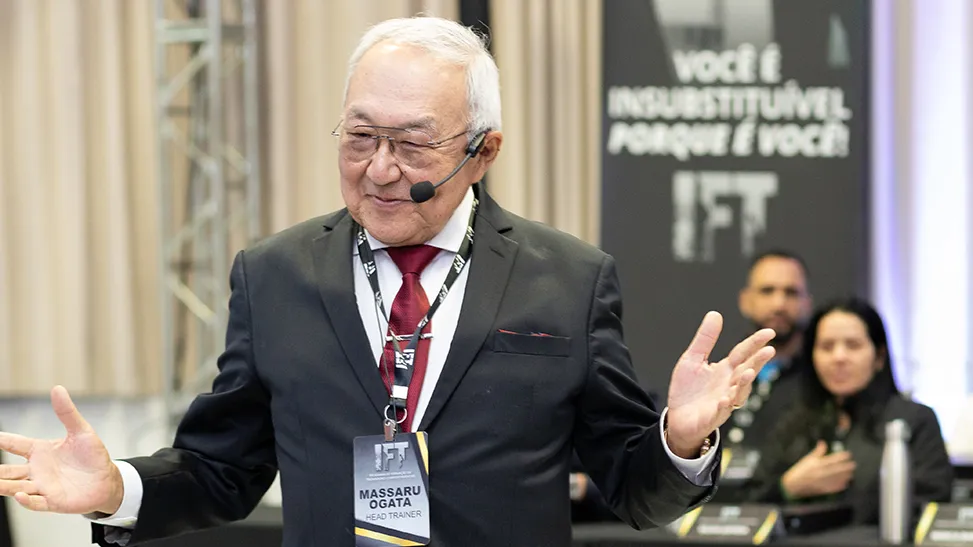
Bianca was born. And grew up sleeping under the legs of the DJ at her father's training sessions. At ten, she begged to take part in the Alpha Connection. At twelve, she was given permission — and walked on hot coals, did a free fall, dove headfirst into a high-impact dynamic that most adults face with trembling. At seventeen, she was running training sessions herself. Today she is managing partner of IFT, Head Trainer at Ânima Training and a specialist in systemic constellations — an area she developed herself within the institute. "She was meant to come," he says simply. "It can only have been a miracle. And she came to carry on the legacy."
When the subject is legacy, Massaru does not speak of retirement. He speaks of a trip to Italy — Rome first, then Tuscany, with an international immersion included. He speaks of deep-sea fishing, of 550 tilapia caught one by one in a day and a half at the farm, alongside his son who came from Canada to visit. He speaks of cooking, researching recipes on Instagram, experimenting with new sauces on old recipes. He speaks of continuing to move — and of continuing with the humility to sit as a student whenever there is something to learn. "The day I say I know everything about human development," he warns, "is the day I know nothing. I know I must maintain that humility. Because selling yourself through ego means selling yourself cheap."
"People who choose stagnation choose the valley," he says, with that calm firmness that only comes from someone who has seen enough. "And the valley is the place chosen for the cemetery. So don't allow it. Keep dreaming. Find your reasons to get up in the morning." At 80, he still has his — and takes the stage every week to prove it.
Massaru Ogata is founder and Head Trainer of IFT — Instituto de Formação de Treinadores, recognised as the first and largest institute of its kind in Brazil. With over 2,500 certified trainers, he also works in situational leadership and corporate human development. Information: ifttreinamentos.com.br