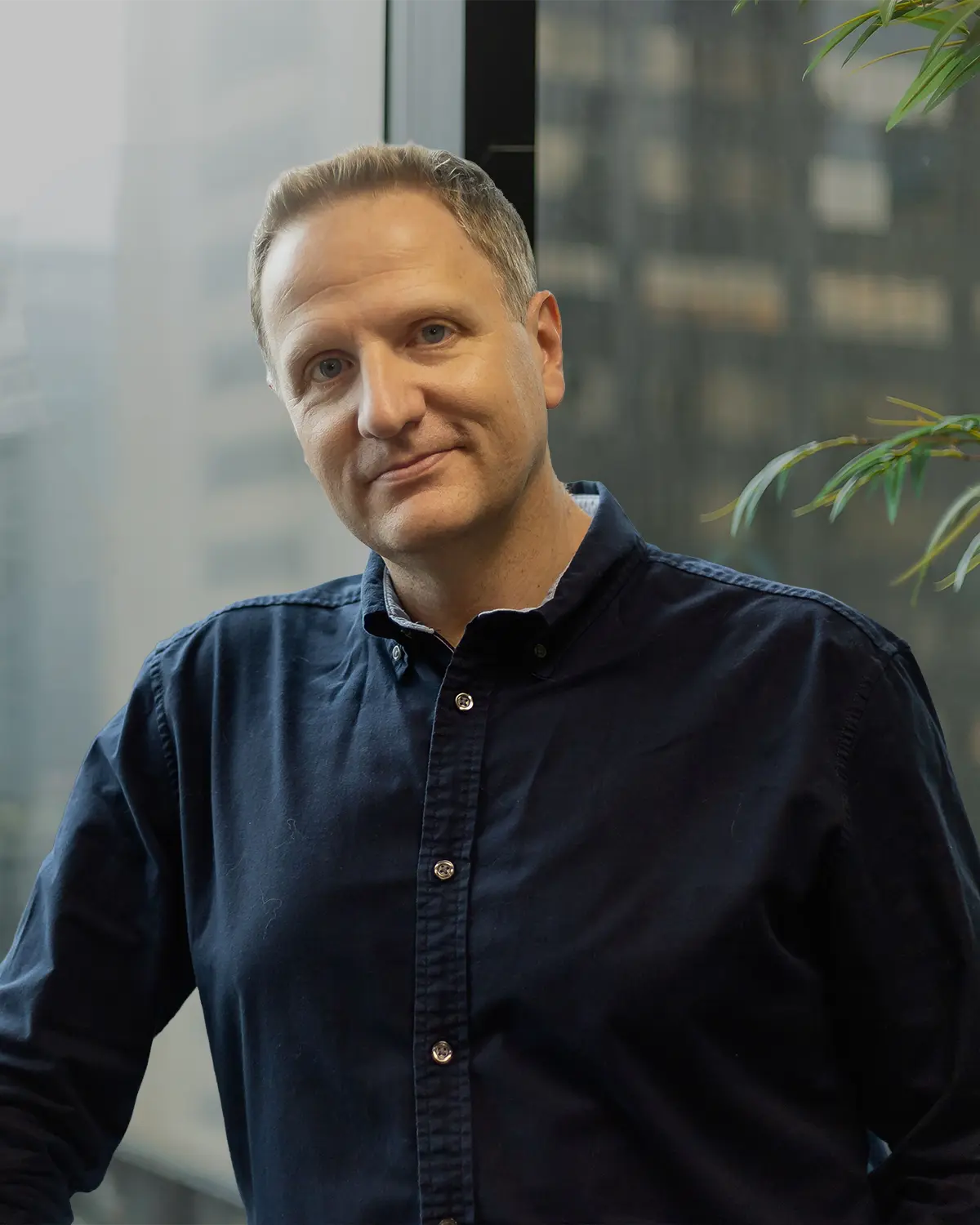
At age 27, Thomas Pillet was working as an internal auditor for the PSA Peugeot Citroën Group and was traveling to Brazil for work, with no plans to stay. On one of those trips, he reconnected with colleagues who had settled in the country and was intrigued by the lives they had built here. The initial idea was simple: to spend two, maybe three years here. Two decades later, that French auditor heads Up Brasil, one of the country’s largest corporate benefits providers, at a time when the industry is preparing for the most profound regulatory change since the creation of the Worker’s Food Program 50 years ago.
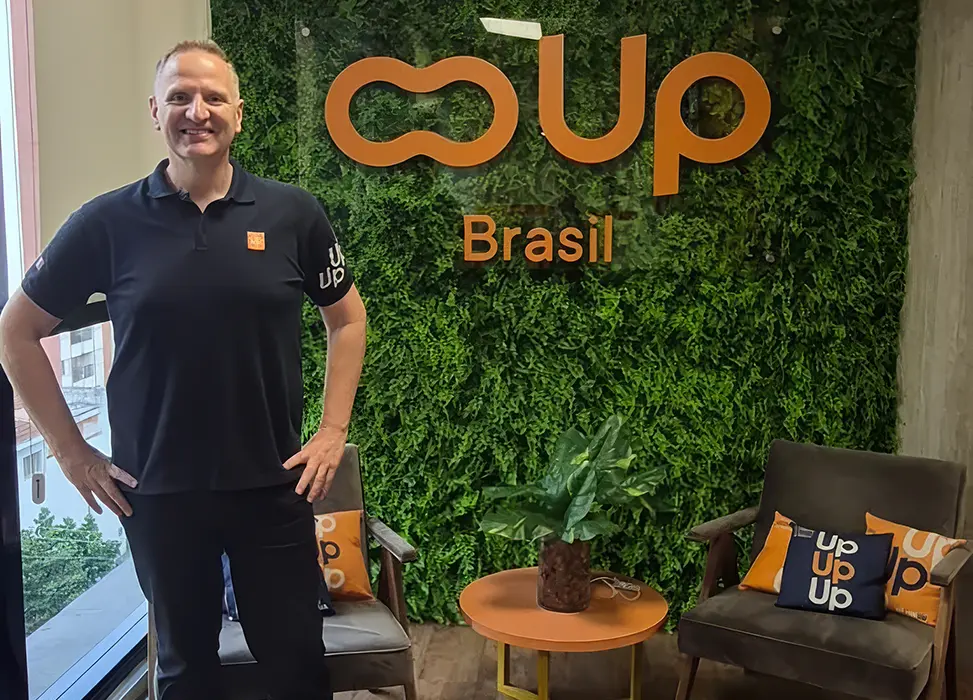
A year after arriving, Thomas met his wife in São Paulo. He started a family, had children, lived in São Paulo and also in Rio de Janeiro, spent some time back in France, and when he decided to return to Brazil for good, he weighed both the proximity to his family and the support network the couple had already built with their young children. “Today I’m Franco-Brazilian,” he says—a phrase that sums up less a dual nationality than a process. He arrived speaking Portuguese reasonably well, but without fully mastering the language, its social codes, or the practicalities of daily life, including safety issues. His understanding of the country, he says, came from experience, not theory—and from his wife, who even today corrects him, good-naturedly, when a reaction is “too French.”
Before joining Up, Thomas worked at ADEO, the group that owns Leroy Merlin, where he says he brought back less in the way of retail practices than a vision of culture and people—the ability to welcome, develop, and promote professionals who started out at the register or in logistics all the way up to leadership positions. In subsequent roles, he also brought—in his own words—the opposite: the realization of what toxic environments can do to a team.
He joined Up Brasil as one of the CFOs in April 2018 and took over as CEO in January 2023—nearly five years between the two roles. The transition began well before the announcement: when, following a restructuring, he took over as CFO for Brazil in 2020, in the midst of the pandemic—a period marked by difficult decisions and organizational adjustments. In the second half of that year, he began the board member certification program through the Brazilian Institute of Corporate Governance, which he completed in June 2021—a first step, he says, that opened up horizons beyond finance. He learned of the promotion far enough in advance to undergo a coaching process and take a course on innovation and digital transformation at INSEAD before assuming the role. The transition with his predecessor, with whom he had worked for four years, went smoothly; the two remain friends to this day.
As CEO, his perspective shifted from individual functions to the system as a whole: culture, product portfolio, digitization, relationships with HR clients and retail partners, employee development, governance, and social impact. “It’s a much more systemic perspective,” he summarizes.
“I don’t want Up Brasil to simply hand out a card. I want our products to make a difference in people’s lives.” — THOMAS PILLET
One of the things that most caught Thomas’s attention when he entered the Brazilian benefits market was its historical logic: organized around the HR client—who signs the contract—rather than around the person who actually uses the benefit. The company contracts for the card; the employee didn’t choose that brand and, for decades, didn’t need to be at the center of anyone’s strategy. On the other end of the chain is the merchant, which often views the provider as a pure cost. Part of the transformation that Thomas says he is pursuing at Up is precisely this: creating value for all three stakeholders—HR, the user, and the merchant—rather than focusing solely on whoever signs the contract.
The Biggest Shift in Five Decades
In November of this year, the benefits sector is set to experience what is already being called, both inside and outside Up, one of the biggest transformations in five decades: the interoperability of Worker Meal Program cards. Currently, an Up card can only be used at establishments previously accredited by the operator itself, through a vetting process that requires regular registration and up-to-date health inspections—a safeguard designed to ensure that benefit funds are used safely and for their intended purpose. With interoperability, the Up card will be able to be used at other PAT operators’ networks, and vice versa, broadening the range of options available to workers.
Thomas views the change as positive, provided the operating cost remains reasonable—it reduces one of the main barriers to market entry and truly enhances the user experience. The problem today is that the industry still does not know how interoperability will be implemented, nor what its cost will be, which is causing widespread concern among operators.
To navigate this change, Up brings scale to the table: approximately 10,000 HR clients, more than 1 million users across its various solutions, and operations in both closed and open models. It’s a favorable position, but no reason to rest on one’s laurels—“a changing market requires even established companies to keep reinventing themselves,” he says. An international comparison helps put the scale of the challenge into perspective: Brazil currently has more than 400 companies accredited under the Worker Food Program, compared to about 30 in France and a similar number in Mexico—which Thomas interprets as a sign of competitiveness, not bloat.
Sitting on Both Sides of the Table
Thomas also serves on the board of the Brazilian Association of Employee Benefits (ABBT), while leading one of the sector’s largest operators—a position that frequently requires him to distinguish between what is good for Up and what is good for the market as a whole. He is a certified governance advisor recognized by both the Brazilian Institute of Corporate Governance and Harvard Business School, and he treats governance as a compass: without proper and responsible execution, he says, even the best strategy ends up compromised.
ABBT’s strength, he says, stems from its very diversity—more than 20 stakeholders who helped transform the PAT into a program recognized by the International Labor Organization as an international benchmark. And it is from this diversity that divergent interests arise: “We can’t agree on everything; that would be utopian,” he sums up.
Where Growth Comes From
Not all growth in the sector stems from the same source. In large companies, benefits are already part of the compensation package; at most, there may be a change in provider—what changes is the additional offering added to the original benefit, such as a meal voucher paired with a gym membership or a salary advance. A significant portion of Up’s growth, says Thomas, comes precisely from this cross-selling. But there’s a second front growing even faster: smaller companies, which historically offered no benefits at all, are now seeking to supplement salaries in a more tax-efficient manner. It is among this audience, he states, that Up currently identifies the strongest potential for expansion.
Well-being from the Inside Out
Since Up was last featured in the pages of this magazine, with its wellness card taking center stage, the strategy has evolved into a broader ecosystem. One example is UpAgiliza, developed in partnership with Benefício Certo: it began by allowing users to recharge São Paulo’s Bilhete Único transit card via cell phone, moved on to balance inquiries, and by March of this year had already surpassed R$1 million in reloads—Up’s first step toward urban mobility.
The company also began measuring its own customer service quality using an internal index that combines external and auditable indicators: app ratings, the space they occupy on a smartphone, ratings on Reclame Aqui, and the RA1000 seal. The result places Up among the top three in the market, including both established players and more digitally focused competitors. On the artificial intelligence front, Thomas describes Up as a case study within the French group Up Coop itself—one of the leading global players in the corporate benefits market, operating in over 25 countries and of which the Brazilian company is a part—used for both decision-making and new product development. In information security, the Brazilian operation achieved the NIST Foundation level one year ahead of the deadline set by the group and was the first international unit to be audited and validated by the cybersecurity team in France.
Internally, Up earned the GPTW seal for the second consecutive year and ranks among the top three in the engagement survey conducted annually by the group, which comprises approximately 50 business units across all countries. “Well-being comes from the inside out,” Thomas summarizes.
Cooperative roots, operations adapted to the tropics
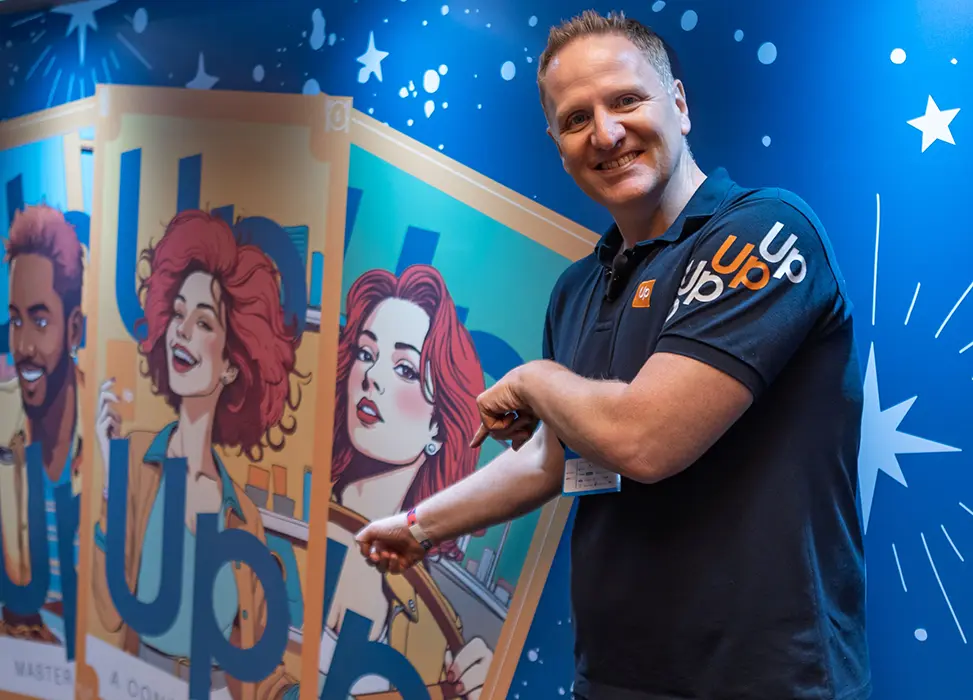
Up was founded in France as a cooperative—with strong values of equality, employee participation, and profit sharing. The Brazilian operation is not a cooperative, and Thomas is categorical: it would make no sense to copy the French model. What he seeks, in his own words, is to “adapt” these concepts to the local context. A concrete example: In 2024, Up Brazil increased the percentage of profits distributed to employees, excluding leadership from the increase—the additional amount was divided equally among all frontline employees, narrowing the gap between them and leadership without copying the egalitarian distribution that exists among French cooperative members. Another sign of this same trend: two employees elected by their peers—one woman and one man, reflecting the gender parity stipulated in the French board’s articles of association—now serve on the Board of Directors in Brazil.
This does not mean deciding everything by consensus. According to Thomas, the cooperative DNA is evident in the way people and governance are viewed, not in the speed of operational decisions. To reconcile the two, he requires that every proposal reach the executive committee already formalized in writing, with mandatory questions and answers and opposing arguments clearly stated—including those of those who disagree. This advance preparation, he says, shortens meeting times and transforms an initial conviction—based on 90% certainty—into a more balanced decision.
“The risk would exist if we entered products simply because the market is moving in that direction.” — THOMAS PILLET
What Employees Expect Today
The Corporate Well-Being 2025 survey, conducted by Up itself, measured this gap between rhetoric and perception: 52.1% of professionals cite recognition as the most important factor for well-being at work—above meal benefits, cited by 33.8%. And while 85% of HR professionals state that their companies have structured wellness programs, only 45% of employees share that perception.
It is this type of data that guides Up’s recent investments in pharmacy, fuel, and credit. The criterion, according to Thomas, is not to follow trends: it is to solve real problems connected to the company’s purpose. Well-being means different things to different people—for some, it’s the meal voucher that covers their monthly groceries; for others, it’s the gym; for still others, it’s mental health or access to medication. “There would be a risk if we entered product categories simply because the market is moving in that direction,” he says—and it is this discipline, more than any single product launch, that he points to as protection against the risk of the brand becoming too generic.
When asked how he wants to be remembered, Thomas doesn’t talk about numbers or results. He speaks of a journey in which he gradually took on greater responsibilities and, with them, broadened his own vision of leadership. The transition from CFO to CEO broadened his perspective—which had previously focused mainly on finance—to encompass business transformation, innovation, and the search for new solutions capable of keeping pace with market changes and the needs of employees.