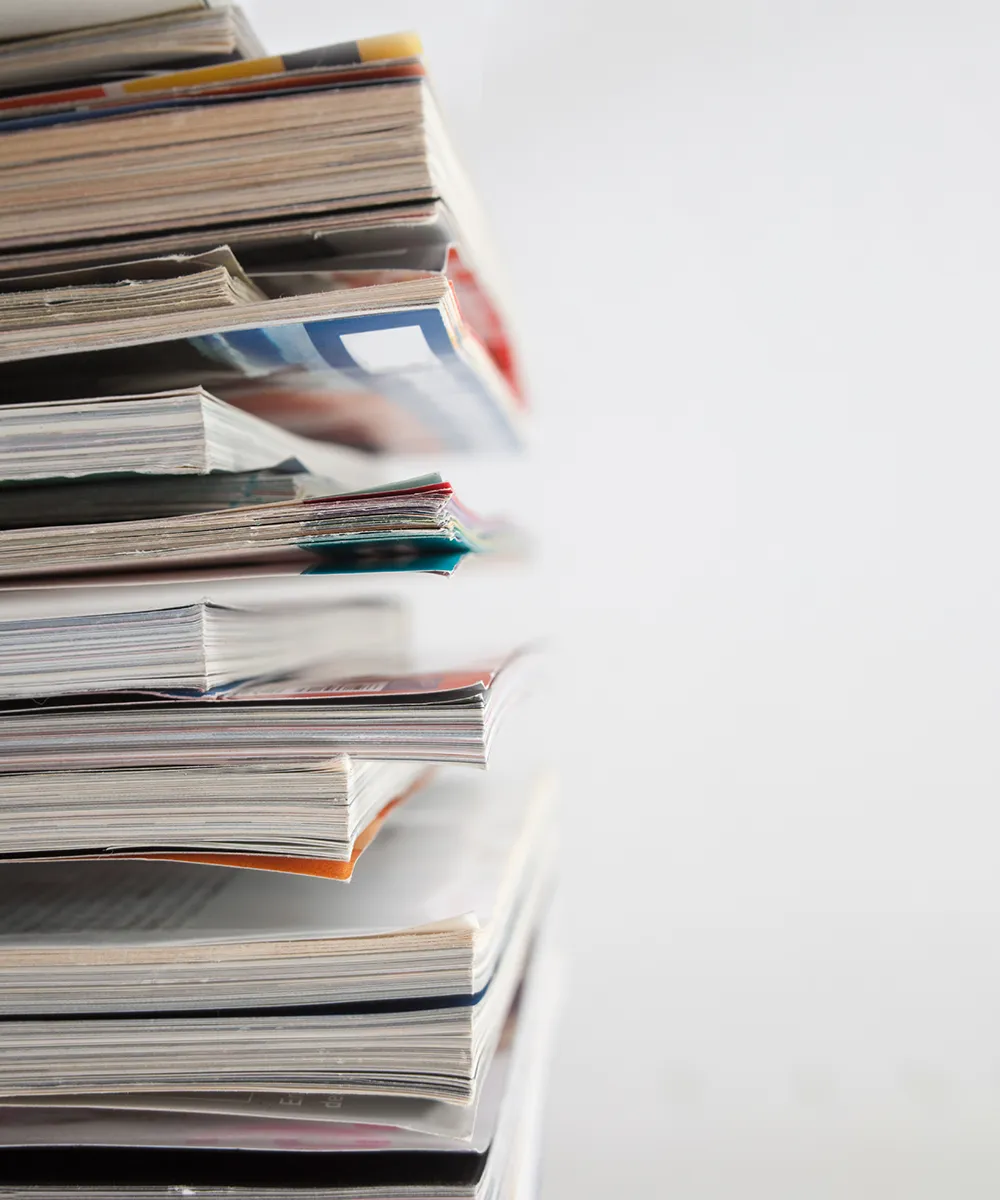
There was a near-universal belief in the early 2010s: print was dead. Magazines would disappear. Paper would permanently give way to screens. More than a decade later, the market tells a different story — and more and more companies, associations and business networks are rediscovering something that digital, for all its speed, has still not managed to replicate: the authority that comes from an object held in the hands.
The numbers that bust the myth
The books, newspapers, magazines and stationery segment posted 6.9% growth in 2025 in Brazilian retail — outperforming many other segments of national commerce, according to the Stone Retail Index. Globally, the physical publications market moves more than US$ 120 billion and has over 7,000 magazines in active circulation. In the United States, more than 70 new print magazines were launched in 2024 alone.
In Brazil, the movement gained visibility through landmark cases. In December 2024, Capricho returned to newsstands after 10 years exclusively digital — and sold out 80% of copies in its first issue. In March 2025, Manchete reappeared after 25 years of inactivity. Bloomberg Businessweek relaunched its monthly print edition after 94 years as a weekly. These are not nostalgic gestures. They are strategic bets made by organizations that understood what the data was already confirming.
"Digital democratized publishing, but it didn't democratize credibility. Anyone can post — and that's exactly why those who publish with rigor, editorial curation, graphic design and editorial responsibility stand out more and more. Print is, today, an act of courage and commitment." — Alexandre Almeida, partner at Alef Design + Editora
Digital fatigue: the phenomenon that changed the game
There is a technical name for what many already feel in practice: digital fatigue. After years of notification overload, endless feeds and disposable content produced in seconds, readers and companies have rediscovered the value of what is planned, edited, printed and delivered with care. The magazine — especially the corporate and niche variety — now occupies a territory that the internet paradoxically created by saturating its own audience.
When a person holds a magazine in their hands, behavior changes. There is no notification to interrupt. No algorithm deciding what they read next. There is an editorial sequence thought through by someone who knows the reader, respecting their intelligence and their time. Consumer neuroscience research shows that reading on paper generates greater information retention and deeper emotional engagement than reading on screen — data that major luxury brands already use as a central argument for maintaining their print publications.
Print doesn't compete with digital — it anchors it
The logic that prevails today is not one of opposition between paper and pixel, but of strategic complementarity. A well-produced magazine generates content for months of digital presence: articles that become posts, interviews that feed podcasts, data that sustain newsletters. Print doesn't fight digital — it elevates everything that comes after.
Fernanda Sodré, partner at Alef Design Editora, sees this movement from the inside: "The company that publishes a magazine communicates something no post can communicate: that it invested time, curation and resources to deliver real value to its audience. That alone is already a brand declaration. When the reader holds that object in their hands, they have already formed an opinion about who produced it — before reading the first line."
Brands that publish magazines are perceived as more trustworthy, more established and more committed to their market. In an environment where anyone can create a profile and post in seconds, print functions as a filter for seriousness. It says, without needing to say it: this organization exists, thinks, and cares.

Twenty years, multiple markets, one method
Alef Design Editora arrived at this moment with a rare accumulation: more than two decades coordinating and giving graphic form to publications for radically different audiences, each with its own visual language, editorial rigor and distinct identity. Alef's role in these magazines is not to write — it is to create the architecture that makes the content breathe: the graphic design, the layout, the visual hierarchy, the identity of each issue. And doing this well requires deeply understanding the universe of those who will hold that magazine in their hands.
At Sogesp — the São Paulo State Society of Obstetrics and Gynecology — the graphic design must convey the scientific seriousness of one of the state's largest medical societies. At Sobrac — the Brazilian Society of Climatology — the visual identity carries the specificity of a specialty that unites science and women's health. At Abdor — the Brazilian Association for the Study of Pain and Orthopedics — the publication brings together studies, clinical discussions and advances in understanding musculoskeletal pain: dense content read by orthopedic surgeons that requires a design capable of organizing complexity without losing elegance. At the SBC Magazine — Brazilian Society of Oncology — every design decision carries the weight of one of medicine's most demanding specialties.
Outside the medical universe, Alef also signs Empreenda, the magazine of entrepreneur Elaine — a publication aimed at the world of business and female entrepreneurship, with language, palette and visual identity completely distinct from the scientific publications. It is precisely this diversity of niches that defines Alef's differentiator: there is no single house style. There is the capacity to create the right style for each universe.
BNI Magazine: where method meets mission
When Alef took on the production of BNI Magazine, the challenge was of a different nature — not because of technical demands, but because of the nature of the content. Here, the protagonist is not scientific knowledge or peer debate. It is the entrepreneur. The person. The trajectory built with effort, decision and vision.
And it is exactly here that the magazine fulfills a strategic function that goes beyond communication: it becomes a showcase. The member who appears in its pages gains qualified visibility before the entire network — their peers, potential partners, future clients. A well-told story in a printed magazine carries a weight no sponsored post can buy: it positions, it differentiates, it endures.
For a network whose most valuable capital is the trust among its members, this has immense value. A post disappears in hours. A printed article stays on the desk, in the waiting room, on the shelf. It can be re-read, shared, kept — and every time that happens, the member's name circulates again.
"In BNI, everyone has a story worth telling. But telling that story in a way that inspires, that positions, that makes the reader see that entrepreneur as a reference — that requires craft. It's not just interviewing and transcribing. It's building a narrative that opens doors." — Fernanda
That is exactly why BNI Magazine matters beyond what it shows. It is not merely a communication vehicle for the network. It is an authority platform for each member who appears in it — and concrete proof that belonging to BNI means being seen, recognized and remembered.
What lies ahead
The growth of corporate publications in the coming years will not be accidental. It will respond to a need the market already feels: amid digital noise, organizations that know how to use print as a strategic tool will get ahead. Not because paper is superior to pixels — but because the combination of both, well executed, creates real presence across multiple dimensions.
"When I started in this market, the question was whether investing in a magazine was worth it. Today, the question has changed: companies ask how to do it well. And that shift says everything about where the market is headed," concludes Fernanda.